
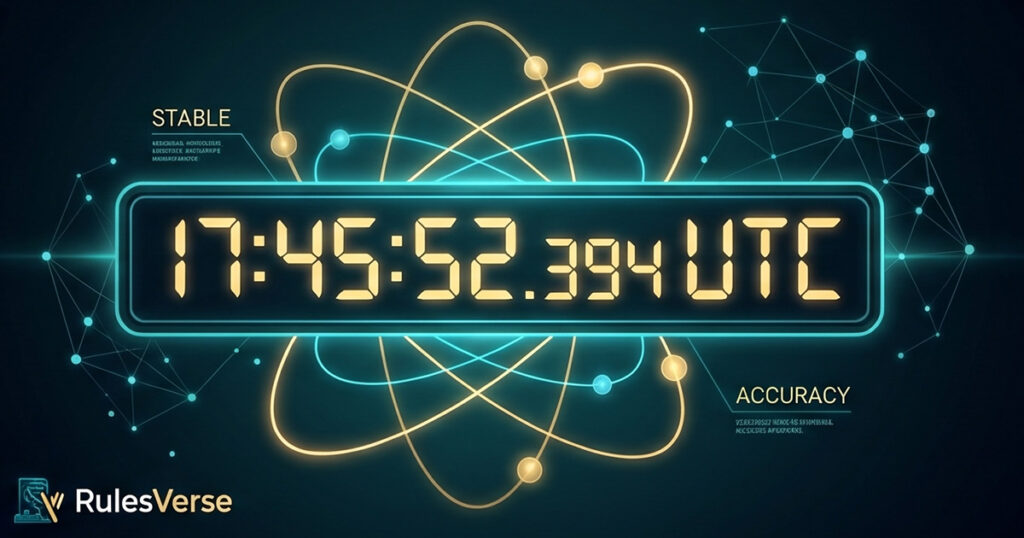
How to Use Our Precision Online Atomic Clock
Our online atomic clock provides an immediate, millisecond-accurate reference time synchronized directly with international primary time standard servers. Whether you are setting a manual wristwatch, timing accurate scientific observations, verifying time stamps for online transactions, or simply adjusting your home devices, this live digital display guarantees absolute accuracy without manual calibration.
Key Features and Benefits
- Automatic Network Synchronization: The displayed time continuously references Network Time Protocol (NTP) servers to offset local system hardware discrepancies.
- Universal Coordinated Time (UTC) Standard: Aligned with primary Cesium frequency standards used worldwide by scientific institutions, telecommunication networks, and aviation systems.
- Zero Latency Offset Display: Automatically compensates for network transfer delays to deliver accurate timekeeping directly to your web browser on desktop, tablet, or mobile devices.
Frequently Asked Questions – Atomic Clock & Time Sync
What is an atomic clock and how does it work?
An atomic clock is the most accurate timekeeping device in existence. It measures time by monitoring the resonant frequency of atoms (typically Cesium-133), resulting in an error of less than one second over millions of years.
Why is this clock more accurate than my device’s internal clock?
Standard quartz clocks inside phones and computers can drift over time due to temperature fluctuations and hardware aging. Our clock synchronizes directly with primary Network Time Protocol (NTP) time servers to deliver precise time.
How often is the displayed time synchronized?
The time is fetched upon page load and continuously calculated against server offset to ensure real-time accuracy down to the millisecond.
What is a leap second?
A leap second is a one-second adjustment applied to Coordinated Universal Time (UTC) to compensate for variations in Earth’s rotational speed, keeping atomic time aligned with astronomical time.
Understanding Atomic Clock Technology and Exact Time Synchronization
An atomic clock is the most precise timekeeping device ever created by humanity. Unlike conventional mechanical or quartz clocks that rely on physical pendulums or vibrating crystals, atomic clocks measure time by observing the ultra-stable resonance frequencies of atoms—typically Cesium-133 or Rubidium. Because these atomic oscillations occur at precise physical constants, an atomic clock experiences virtually zero drift over millions of years, providing the absolute global standard for Coordinated Universal Time (UTC).
Why Millisecond-Accurate Time Matters in the Digital Era
In our modern interconnected world, precise time synchronization powered by an accurate atomic clock reference is essential across numerous technical and everyday applications:
- Financial Transactions: High-frequency trading platforms require microsecond-level timestamps to execute orders fairly and prevent market manipulation.
- Network Security and Logging: Cybersecurity systems rely on synchronized system logs across servers to trace authorization events and detect intrusion attempts.
- Data Synchronization: Cloud databases and distributed server clusters use atomic time standards to maintain data consistency across global regions.
- Navigation and GPS: Satellite navigation systems calculate precise physical positions based on the exact time signals transmitted by onboard atomic timekeeping units.
How Network Time Protocol (NTP) Works Under the Hood
When you view our live online atomic clock, your web browser communicates with synchronized Network Time Protocol (NTP) time servers. These primary time servers (known as Stratum 1 servers) are directly linked to physical atomic clocks (Stratum 0 references) maintained by national metrology institutes. Our client-side algorithm continuously measures round-trip network latency between your browser and the server, automatically compensating for delay offsets to display exact, real-time UTC down to the millisecond.
Frequently Asked Questions About Online Atomic Clocks
How often does this atomic clock update?
The digital display updates dynamically every millisecond based on continuous high-precision browser timers calibrated against standardized NTP server timestamp requests.
Is my computer’s internal clock accurate?
Most local computer and smartphone clocks rely on basic quartz oscillators that can drift by several seconds per week due to temperature changes and battery wear. Using our online atomic clock allows you to instantly verify and calibrate your local system time against true Coordinated Universal Time.
What is Coordinated Universal Time (UTC)?
Coordinated Universal Time (UTC) is the primary time standard by which the world regulates clocks and time. It is derived from International Atomic Time (TAI) with leap seconds added at irregular intervals to compensate for the earth’s slowing rotation.
Explore Our Health & Fitness Calculators
If you are managing your daily health and fitness routines alongside precise timekeeping, try our other free calculator tools:
- BMI Calculator – Check your Body Mass Index and target weight categories.
- Calorie Calculator – Calculate your Total Daily Energy Expenditure (TDEE).
- Ideal Weight Calculator – Determine your ideal target weight based on clinical formulas.
- Macronutrient Calculator – Optimize your daily protein, carb, and fat ratios.
- Water Intake Calculator – Find your personalized daily hydration goals.